ERVR: Emergency Room VR

ERVR

Emergency Room VR: High-fidelity emergency medicine simulation

Emergency-room training in VR

Northdocks and the University Hospital of Cologne developed ERVR (Emergency Room VR) for interprofessional trauma teams. Medical professionals work through realistic emergency-room scenarios, managing patients from arrival to transfer. The simulation focuses on process management, team coordination, and decision-making under pressure.

Trainees assume specific roles (e.g., team leader) and coordinate with virtual colleagues (NPCs) or real teammates. The system supports the cABCDE schema for trauma care, ensuring adherence to critical protocols.

ABCDE Approach & Clinical Protocol

The simulation is built on the cABCDE schema, the standard protocol for structured trauma assessment covering Catastrophic bleeding, Airway, Breathing, Circulation, Disability, and Exposure. Trainees apply systematic clinical reasoning under time pressure, mirroring real shock room workflows.

Key VR Features:

  • Role Selection & Team Configuration: Choose roles and configure your trauma team with virtual colleagues from different disciplines.
  • Advanced Interaction: Command virtual colleagues via Voice Chat or click interface to perform tasks like ‘Apply 3-lead EKG’ or ‘Perform Ultrasound’.
  • Real-time Physiology Engine: Patient vitals react dynamically to interventions (medication, ventilation) and condition changes.
  • Procedural Simulation: Realistic workflows for IV access, medication administration, intubation support, and diagnostics.
  • Comprehensive Debriefing: Detailed logs and timeline analysis of all actions for effective post-training review and error management.
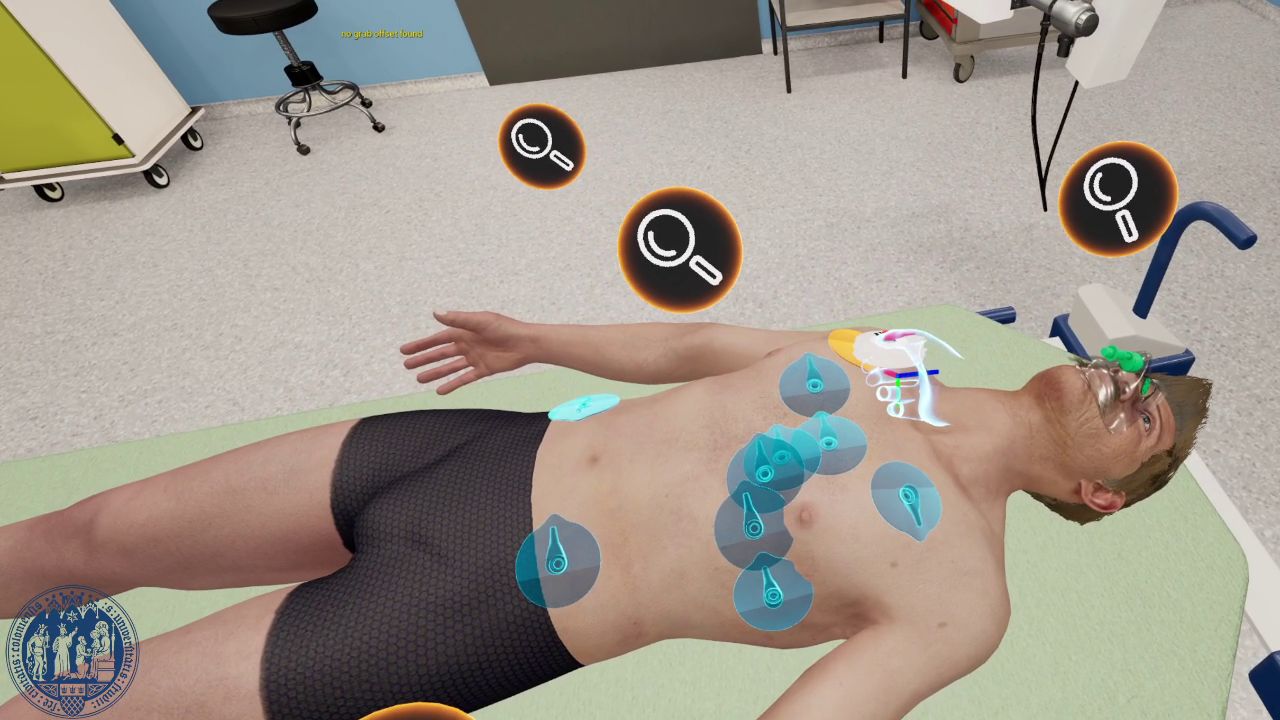
Shock Room VR Training: Team managing a virtual emergency scenario

Partner:

University Hospital Cologne Logo

University Hospital Cologne

See It in Action

Watch ERVR in action. See how medical teams coordinate emergency-room protocols in a fully immersive virtual environment.

Frequently Asked Questions: ERVR / Emergency Room VR

What is ERVR and how does it work?

ERVR (Emergency Room VR) places physicians and nurses in a photorealistic virtual emergency room. The team assumes defined roles and manages a critical patient using the cABCDE schema, from initial assessment to transfer. A physiology engine simulates vital signs in real time.

Who is ERVR designed for?

The training targets emergency physicians, surgeons, anaesthesiologists, and emergency nurses. Ideal for simulation centres, university hospitals, and clinics seeking scalable interprofessional team training.

Which scenarios are included in ERVR?

The simulation covers polytrauma, cardiovascular emergencies, and acute patient deterioration based on the cABCDE schema. Scenarios, difficulty, and patient parameters are fully configurable.

What VR hardware is required?

The training runs on standalone VR headsets (Pico / Meta Quest), no expensive infrastructure required. Multiple participants can train simultaneously in multiplayer mode from different locations.

How does ERVR differ from traditional simulation training?

VR training is scalable, lower-cost, and available on demand. It is ideal for repeating standardised procedures and preparing for high-pressure situations, as a complement to traditional high-fidelity simulation.

Ready for the Paradigm Shift in Medical Education?

Request Demo